
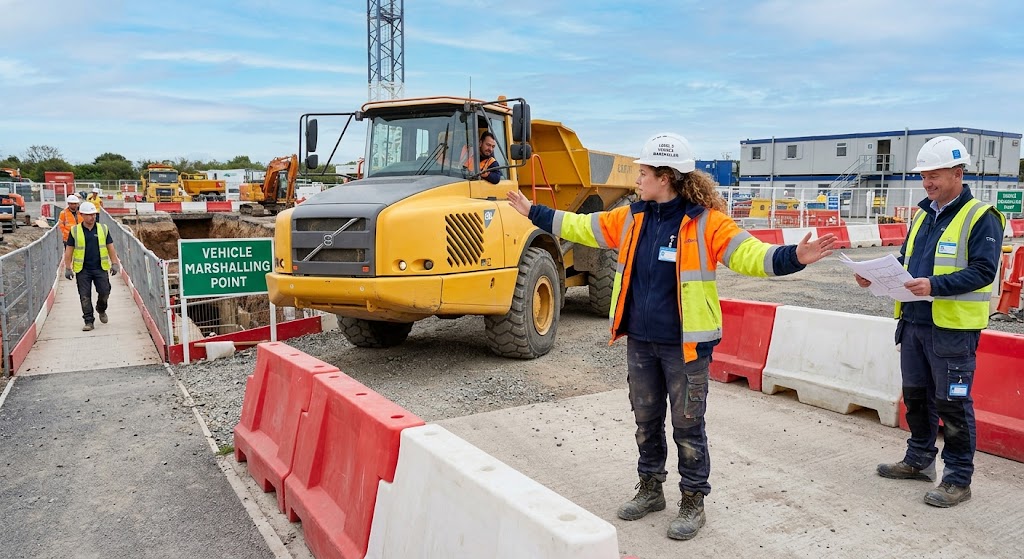
Level 2 Blue Card Vehicle Marshaller
Are you trying to manage busy site traffic flows safely and efficiently? Navigating tight delivery zones with heavy excavators or dumpers requires clear direction. Therefore, securing your official Blue Card Marshaller credential is an excellent way to prove your professional transport safety competence.
This ultimate guide covers the complete pathway to achieving this essential UK construction credential. We will explain workplace portfolio requirements, health safety rules, and career development. Consequently, you can upgrade your credentials with complete confidence.
What Is the Level 2 Blue Card Vehicle Marshaller?
This specialized role forms the defensive backbone of transport safety on busy construction developments. Specifically, you control heavy vehicle access routes and manage reversing delivery lorries safely. Furthermore, you protect nearby pedestrians from moving plant machinery hazards.
An untrained worker can only assist with basic duties under strict supervision. However, a certified Blue Card Marshaller manages high-risk loading bays independently on major infrastructure projects. Therefore, this premium designation validates your advanced traffic control knowledge.
Why the Level 2 Blue Card Marshaller Qualification Matters
UK site management teams never compromise on vehicle safety standards during daily operations. Because of this, they require verified qualifications for all active traffic control staff. The official NVQ pathway serves as definitive proof of your practical capability.
Furthermore, temporary red cards expire quickly and do not allow for multiple extensions. You must complete your work-based vocational portfolio within twenty-four months to stay employed. Consequently, upgrading your status protects your livelihood.
Who Should Apply for the Level 2 Blue Card Marshaller Pathway?
This specific educational framework perfectly suits active site gatekeepers seeking career progression. Similarly, general laborers can use this pathway to step up into formal safety positions. Logistics coordinators who manage transport layouts will also find this qualification useful.
Moreover, commercial construction employers routinely sponsor their teams for this professional upgrade. Therefore, this framework helps anyone aiming for long-term site logistics management.
Eligibility Requirements for the Blue Card Marshaller
You must satisfy several basic prerequisites before starting this professional vehicle marshalling program. Firstly, you must hold an entry-level red card or possess equivalent site experience.
Secondly, you must pass the relevant CITB health, safety, and environment touch-screen test. You must complete this exam within two years of your registration date. Subsequently, you can register with an accredited assessment provider.
How To Get a Level 2 Blue Card Marshaller
The journey to your permanent competence card relies entirely on demonstrating practical skills. Specifically, an expert assessor evaluates your real-world traffic management capabilities on site.
Furthermore, you do not need to take stressful classroom exams or written essays. You simply collect real work documents from your ongoing site projects. Consequently, you can earn your credential smoothly while working.
Qualification Units for the Blue Card Marshaller
The national curriculum features multiple mandatory units that verify your daily transport management capabilities. Each unit covers a specific sector of traffic safety.
Health and Safety Responsibilities
Traffic marshallers must maintain a highly secure environment for all site visitors. Therefore, this unit confirms your detailed understanding of the Health and Safety at Work etc. Act 1974. You will learn to eliminate vehicle collision hazards before accidents happen.
Additionally, you will learn to implement robust workplace transport safety guidance. Consequently, you protect your site team from severe injuries.
Managing Vehicle Movements
Every successful delivery requires precise control and clear routing through the site gates. This unit teaches you how to coordinate heavy site transport movements safely. For example, you must ensure vehicles turn safely on unstable ground surfaces.
Furthermore, you will study how to manage blind spots around large dumpers. Therefore, you ensure machinery moves without endangering nearby property.
Directing Construction Traffic
A major part of your role involves keeping vehicle flows moving smoothly. This unit teaches you how to organize traffic arrival schedules efficiently. You will manage delivery holding areas to prevent local road congestion.
Moreover, your traffic management plans must comply fully with CDM 2015 regulations. Thus, you create a highly organized framework for everyday site supply deliveries.
Safe Communication Techniques
A professional marshaller must communicate with drivers using clear and standardized methods. This core unit focuses heavily on mastering HSE-approved hand signals. You will practice giving definitive directions that drivers can understand instantly.
Subsequently, you will establish clear radio communication protocols with crane teams. Meanwhile, you ensure everyone understands the site speed limits
Site Hazard Awareness
Reversing large vehicles into tight spaces creates significant risks for ground workers. Therefore, this module teaches you how to identify visibility hazards rapidly. You will analyze transport routes to remove dangerous obstructions.
In addition, you will specify necessary changes to site lighting or signage. Overall, your hazard awareness ensures compliance with PUWER 1998 guidelines.
Maintaining Safe Work Areas
While directing large vehicles, you must also look after pedestrian safety. This unit confirms you can establish secure separation boundaries across the site. For instance, you must maintain solid physical barriers between walking paths and vehicle tracks.
However, if an unauthorized person enters your zone, you must react fast. Therefore, you must possess the authority to stop all vehicle movements immediately.
Assessment Process
Your allocated NVQ assessor will guide you through the digital portfolio building process. Specifically, they will review your actual workplace documents to verify your competence. They use a blend of modern evidence gathering techniques.
Furthermore, they will conduct a short professional discussion regarding your safety choices. This conversation allows you to explain your traffic layout decisions clearly. Consequentially, you prove your deep understanding of modern traffic management best practices. Below is a summary of the qualification details.
| Qualification Feature | Key Operational Details |
| Official Title | Level 2 NVQ Diploma in Controlling Lifting Operations (Vehicle Marshaller) |
| Assessment Location | Your active UK construction or infrastructure site |
| Core Legislation | CDM 2015, HSAWA 1974, HSE Transport Guidance |
| Card Type Issued | 5-Year Blue Competence Card (CPCS or NPORS) |
| Progression Option | Level 3 NVQ in Construction Supervision |
Evidence Required
You must compile a clear collection of workplace evidence to satisfy external verifiers. This portfolio must reflect your regular traffic control duties.
- Observation Reports: Written statements completed by your assessor during site visits.
- Risk Assessments: Vehicle hazard sheets signed by you and your supervisor.
- Toolbox Talks: Briefing sheets proving you delivered safety updates to drivers.
- Site Layout Plans: Diagrams showing your active delivery gates and barriers.
- Witness Testimonials: Validation letters written by your current site manager.
Subsequently, these files are uploaded to an online assessment portal. Therefore, accurate documentation ensures a quick certification turnaround.
Completing the Qualification While Working
Many busy traffic marshals cannot afford to take unpaid time off for training courses. Fortunately, this vocational NVQ operates entirely on a live working site. You complete your portfolio tasks during your standard daily shifts.
Additionally, you can collect evidence organically as you direct incoming delivery lorries. Thus, the program adapts perfectly to your existing work routine.
How to Obtain the Blue Competence Card
Once your assessor approves your completed portfolio, the center verifies your files. Next, you receive your official level 2 diploma certificate. You can then use this document to claim your card.
Subsequently, the awarding body will print and mail your permanent five-year card. This card replaces your temporary red card immediately. Therefore, you gain instant access to premier tier-one employment networks.
Benefits of Becoming a Blue Card Marshaller Leader
Upgrading your professional credentials delivers massive advantages for your career. Firstly, it elevates your employment value across the construction industry. Companies actively seek out qualified marshallers to meet their legal obligations.
Secondly, it significantly reduces the likelihood of transport accidents on site. By mastering vehicle safety rules, you protect your coworkers. Below is a comprehensive card comparison guide.
| Card Stage | Validity Period | Main Requirement | Primary Purpose |
| Red Trained Card | 2 Years (Fixed) | Basic theory test pass | Learning site traffic skills |
| Blue Competence Card | 5 Years (Renewable) | Completed Level 2 NVQ | Proving full site competence |
| Vehicle Marshaller NVQ | Lifetime Valid | Workplace portfolio compilation | Unlocking the Blue Card |
Career Opportunities
The demand for qualified transport controllers covers multiple large engineering sectors. You can secure roles with major highways contractors or airport development teams. Similarly, housebuilding firms require skilled marshallers for residential sites.
Achieving this qualification helps you progress through advanced construction career guides. Many marshals eventually move into full site supervisor or logistics manager roles.
Course Duration and Costs
The total time required to finish depends on your daily access to vehicle movements. If you manage busy site gates daily, you can finish within four weeks. However, candidates have up to twelve months if needed.
Assessment fees depend on your chosen UK training provider. Fortunately, many companies qualify for CITB grants that cover these costs completely. Therefore, you should consult your employer about financial backing options.
Common Mistakes to Avoid
Many candidates delay their card upgrade by making simple paperwork errors. Avoid these common portfolio mistakes:
- Submitting generic site diaries without personalized task descriptions.
- Forgetting to date your witness testimonial confirmation forms.
- Uploading out-of-focus photographs of your site traffic signage.
- Allowing your CITB health test to expire during the assessment.
- Using non-standard hand signals that violate HSE rules.
Subsequently, check your progress files regularly with your assessor. This care prevents frustrating admin delays.
Tips for Passing the Qualification
Organization remains the ultimate secret to passing your workplace NVQ smoothly. Follow these practical tips:
- Keep a daily log of the different vehicle types you manage.
- Review official HSE transport safety updates to keep your knowledge fresh.
- Ask your site foreman to sign your reference letters promptly.
- Speak clearly and confidently during your recorded assessor interview.
- Ensure your vehicle exclusion barriers are perfectly arranged before taking photos.
Securing your Blue Card Marshaller status is the single best investment you can make for your logistics career. It transforms you from a basic gatekeeper into a highly respected site safety leader. Furthermore, it unlocks the highest-paying transport coordination roles across the UK construction sector.
Take absolute control of your professional future today. Contact an approved vocational assessment center immediately, register for your qualification, and step into a premium site safety role!